
Введение
Пациентам с онкологическими заболеваниями требуется особый подход к проведению анестезии. Риск, связанный с анестезией у таких животных, обусловлен сочетанием следующих факторов: опухолевого процесса, сопутствующих патологий, предшествующего лечения, нутритивного статуса, болевого синдрома, возраста пациента и объема планируемого хирургического вмешательства1,2.У собак и кошек с онкологическими заболеваниями часто наблюдаются анемия, гипопротеинемия, кахексия, нарушения системы гемостаза, органная дисфункция и снижение физиологического резерва1,3,4. Эти состояния влияют на переносимость седации и общей анестезии, выбор лекарственных препаратов для анестезии, скорость восстановления после анестезии и вероятность развития послеоперационных осложнений2,5.
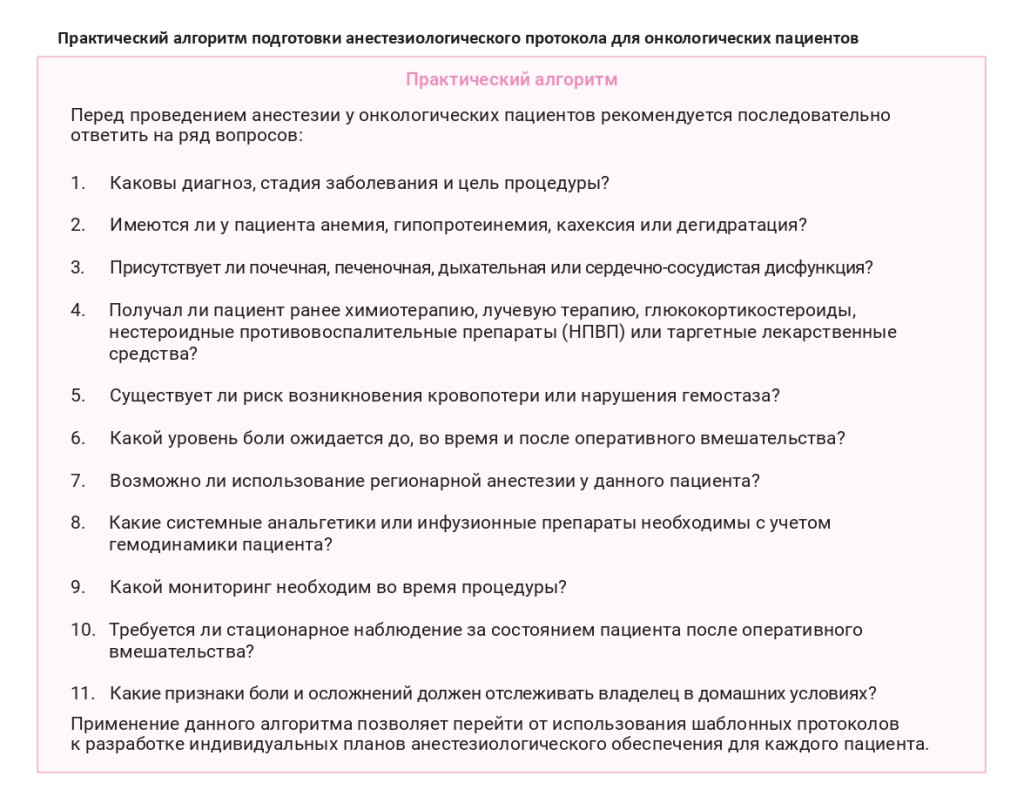
Цель данной статьи – анализ ключевых факторов, которые необходимо учитывать у онкологических пациентов при подготовке к анестезии, а также оценка их влияния на выбор протокола анестезии и анальгезии, мониторинг основных показателей жизнедеятельности и организация послеоперационного наблюдения.
- Salazar V. Neoplastic Disease. In: Johnson RA, Snyder LBC, Schroeder C, eds. Canine and Feline Anesthesia and Co-Existing Disease. 2nd ed. 2022.
- Lamont LA, Grimm KA, Robertson SA, Love L, Schroeder C, eds. Veterinary Anesthesia and Analgesia: The Sixth Edition of Lumb and Jones. 2024.
- Grubb T, Sager J, Gaynor JS, et al. 2020 AAHA Anesthesia and Monitoring Guidelines for Dogs and Cats. J Am Anim Hosp Assoc. 2020;56:59–82.
- Finora K. Common paraneoplastic syndromes. Clin Tech Small Anim Pract. 2003;18(2):123–126. doi:10.1053/svms.2003.36629.
- Grimm KA, Lamont LA, Tranquilli WJ, Greene SA, Robertson SA, eds. Lumb & Jones’ Veterinary Anesthesia and Analgesia. 5th ed. Wiley-Blackwell; 2015.
- Dhaliwal RS, et al. 2023 AAHA Senior Care Guidelines for Dogs and Cats. J Am Anim Hosp Assoc. 2023;59:1–21.
- Baetge CL, Matthews NS. Anesthesia and analgesia for geriatric veterinary patients. Vet Clin North Am Small Anim Pract. 2012;42(4):643–653.
- Bergman PJ. Paraneoplastic hypercalcemia. Top Companion Anim Med. 2012;27(4):156–158.
- Vail DM, Thamm DH, Liptak JM, eds. Withrow and MacEwen’s Small Animal Clinical Oncology. 6th ed. Elsevier; 2020.
- Gruen ME, Lascelles BDX, Colleran E, et al. 2022 AAHA Pain Management Guidelines for Dogs and Cats. J Am Anim Hosp Assoc. 2022;58(2):55–76.
- Fan TM. Pain management in veterinary patients with cancer. Vet Clin North Am Small Anim Pract. 2014;44(5):989–1001. doi:10.1016/j.cvsm.2014.05.005.
- Pinheiro AV, Petrucci GN, Dourado A, Silva F, Pires I. Pain Management in Animals with Oncological Disease: Opioids as Influencers of Immune and Tumor Cellular Balance. Cancers. 2024;16(17):3015. doi:10.3390/cancers16173015.
- Gaynor JS. Control of cancer pain in veterinary patients. Vet Clin North Am Small Anim Pract. 2008;38(6):1429–1448. doi:10.1016/j.cvsm.2008.06.009.
- Clark L. Chronic (or persistent) postsurgical pain: a veterinary problem? Vet Anaesth Analg. 2021;48(1):4–6. doi:10.1016/j.vaa.2020.08.007.
- Wickstead F, Martinez M. A systematic review of the use of peri-operative systemic ketamine in cats and dogs for analgesia. The Veterinary Journal. 2025;312:106350. doi:10.1016/j.tvjl.2025.106350.
- Kaartinen J, Hynes A, Bennett RC. Evidence for the use of total intravenous anaesthesia versus inhalant anaesthetics in dogs: a systematic review. Veterinary Anaesthesia and Analgesia. 2026;53(2):101173. doi:10.1016/j.vaa.2025.101173.
- Cardozo HG, Monteiro ER, Correia BS, Ferronatto JVB, et al. Influence of intravenous fentanyl or dexmedetomidine infusions, combined with lidocaine and ketamine, on cardiovascular response, sevoflurane requirement and postoperative pain in dogs anesthetized for unilateral mastectomy. Veterinary Anaesthesia and Analgesia. 2024;51(4):381–390. doi:10.1016/j.vaa.2024.04.006.
- Pinheiro AV, Petrucci GN, Dourado A, Pires I. Anaesthesia in Veterinary Oncology: The Effects of Surgery, Volatile and Intravenous Anaesthetics on the Immune System and Tumour Spread. Animals. 2023;13(21):3392. doi:10.3390/ani13213392.
- Guo R, Yang WW, Zhong ML, Rao PG, Luo X, et al. The relationship between anesthesia, surgery and postoperative immune function in cancer patients: a review. Front Immunol. 2024;15:1441020. doi:10.3389/fimmu.2024.1441020.
- Comassetto F, Serighelli Júnior G, Iepsen LB, et al. Intravenous lidocaine may contribute to postoperative analgesia without detectable adverse effects in cats undergoing ovariohysterectomy: a randomized trial. J Am Vet Med Assoc. 2026;264(3):297–304. doi:10.2460/javma.25.05.0343.
- McEntee MC. Veterinary radiation therapy: review and current state of the art. Journal of the American Animal Hospital Association. 2006;42(2):94–109. doi:10.5326/0420094.
- Collen EB, Mayer MN. Acute effects of radiation treatment: skin reactions. The Canadian Veterinary Journal. 2006;47(9):931–935.
- Collen EB, Mayer MN. Acute oropharyngeal effects of full-course radiation treatment of tumors of the head. The Canadian Veterinary Journal. 2008;49(5):509–512.
- Iocolano KE, Looney A, Balkman CE, Hume KR, et al. Retrospective evaluation of outpatient intravenous ketamine-lidocaine infusions for the palliation of cancer pain in dogs and cats. J Am Vet Med Assoc. 2024 Dec 26;263(4):499-506. doi: 10.2460/javma.24.09.0595. PMID: 39724771.
- Fry L, Rychel J, Tearney C, Guedes A. Preliminary study of intravenous ketamine infusions for the management of chronic pain in dogs. Veterinary Anaesthesia and Analgesia. 2025;52(1):124.e3–124.e4. doi:10.1016/j.vaa.2024.11.016.
- Pazzi P, Kristensen AT. Thromboembolic disease and hemostatic alterations in tumor-bearing dogs - A narrative review. Front Vet Sci. 2026 Jun 5;13:1818630. doi: 10.3389/fvets.2026.1818630.
 vetpeterburg
 Ветеринарный Петербург